GREY/MARKET BRIEFINGFIELD BIBLE · VOL. 06
Concentrated open-source intelligence
The
RUO
Playbook

How the American research-peptide grey market actually works — the margin machine, the payment war, the branding lab, and the sourcing minefield. Gathered from open sources. No promotion, no condemnation. Just how it is.

RESEARCH USE ONLY · NOT FOR HUMAN CONSUMPTION
EDUCATIONAL DOCUMENT · NOT LEGAL OR BUSINESS ADVICE
COMPILED 2026 · FROM PUBLIC SOURCES
Read before you wire
Contents
// How to read this document

This is a concentration of open-source information about the U.S. research-use-only (RUO) peptide resale market: how the supply chain is structured, where the money is made, where operators get hurt, and how the community separates real factories from professional scammers. It neither encourages nor discourages the business. Numbers marked as illustrative are exactly that; everything load-bearing carries a source marker you can check in the Sources section.

// Non-negotiable context

Nothing here is legal, medical, or financial advice. Peptides sold in this market are unapproved research chemicals. The FDA has repeatedly ruled that an "RUO" sticker does not protect a seller whose totality of circumstances — marketing language, buyer base, residential shipping, dosing content — points at human use.[2][3] Category 2 bulk substances (e.g. Melanotan II, GHRP-2, GHRP-6, LL-37, PEG-MGF) cannot be legally marketed for human compounding under any label.[2] Anyone considering this market needs a qualified attorney before selling anything to anyone.

01The Machine

The grey market is not a loophole that someone found. It is a supply chain that formed when regulated supply was squeezed and demand refused to leave. Understanding it as a machine — five stations, each adding cost and risk — is the difference between an operator and a mark.

Where the market came from

When the FDA moved popular peptides like BPC-157 into Category 2 (effectively banning them from compounding) and restricted compounded semaglutide after the shortage resolved, consumer demand did not disappear — it rerouted. Thousands of online vendors now fill the gap, advertising compounds "for laboratory research only" while operating what amounts to a consumer-facing business.[1] The U.S. RUO market is widely described as the largest grey area in peptide distribution — and the one carrying the most legal risk for owners who believe the label alone is a compliant structure.[2]

The five-station supply chain

SYNTHESIS SPPS factories, mostly China BULK EXPORT powder / lyo vials, unlabeled lots IMPORT US entity, customs, "lab supplies" BRANDING labels, boxes, COA per batch RETAIL D2C website, residential ship EACH STATION ADDS COST — AND A PLACE WHERE AMATEURS GET SEPARATED FROM THEIR MONEY

Open-source reconstructions of the pipeline converge on the same shape: raw synthesis in China, India, or Eastern Europe (where costs are lowest) → bulk import by companies that may or may not be FDA-registered as API manufacturers → packaging and labeling as "research chemicals" → direct-to-consumer websites accepting personal payment and shipping residential → end users guided by Reddit, YouTube, and Telegram rather than clinicians.[1] China alone produces an estimated ~70% of global peptide raw-material supply, and its bulk pricing runs 40–60% below Western equivalents for the same purity grade.[13]

The legal logic — and where it snaps

The RUO frame is simple: these compounds are sold as research chemicals, labeled "for research and laboratory use," with no therapeutic claims — so no one in the chain is formally selling an unapproved drug.[16] The FDA's counter is equally simple: labeling alone does not determine status — the totality of the circumstances does. Who buys, how it is marketed, what the seller knows about intended use, and whether the product ships alongside dosing instructions, syringes, or bacteriostatic water all count.[2]

A genuinely research-only operation, as described by compliance analysts, would sell exclusively to verified institutional buyers with purchase orders, label everything "not for human or animal use," publish no dosing content anywhere, and ship only to verified facility addresses.[2] Almost no consumer-facing grey-market shop meets that bar — which is exactly the tension this document maps.

// Enforcement is the climate, not the weather

CDER warning letters rose ~50% in FY2025 year over year, and peptide-related enforcement ran across every category at once — GMP, telehealth claims, unapproved drugs.[5] In September 2025 alone, FDA sent 100+ warning and untitled letters related to GLP-1 peptides.[5] More than 40 state attorneys general have also pressed FDA and DHS to act against sellers using RUO labels as cover.[2]

Enforcement timeline
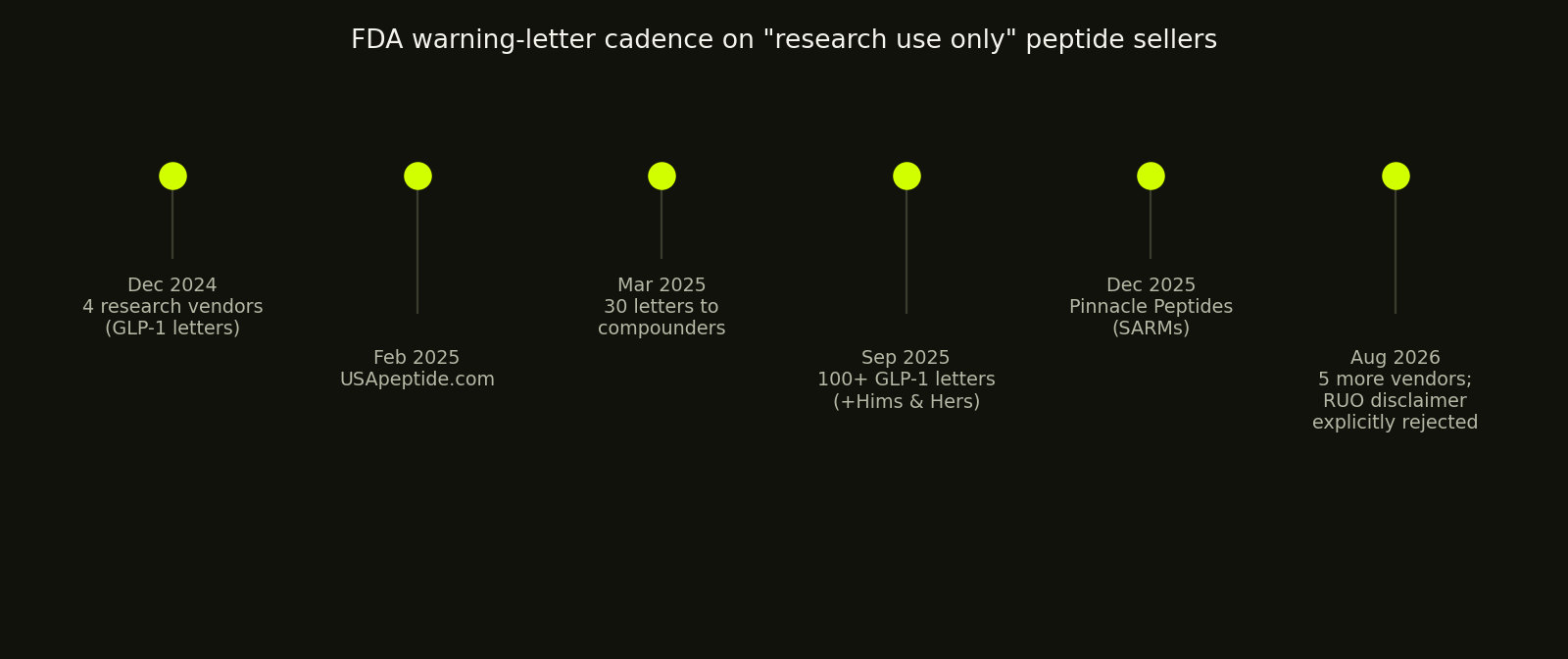
FDA warning-letter cadence on "research use only" peptide sellers, Dec 2024 – Aug 2026 [3][4][5][6]

The August 2026 letters to five vendors — Peak Performance Peptides, Royal Peptides, NuScience Peptides, Peptide Partners, and TXP Innovations (Tex Peptides) — made the agency's position explicit in a footnote: "Despite statements on your product labelling marketing your products 'for research use only'… evidence obtained from your website establishes that your products are intended to be drugs for human use."[3] The same language appeared in the December 2024 batch against Prime Peptides, Summit Research Peptides, Swisschems, and Xcel Research — Summit was sunk by its own Facebook posts about "Enhanced Weight Loss."[4][5]

// Chapter takeaway

The machine runs on a real legal distinction (research chemical vs. drug) and a practical fiction (who the buyer really is). Every downstream skill in this playbook — payments, COAs, branding language, sourcing — exists to manage the gap between those two. Operators who understand the machine price the risk in. Operators who don't, discover it by letter.

02The Margin

The number that recruits people into this market is real: community lore quotes ~$3 factory vials against $50+ U.S. listings. The number that bankrupts them is the one they never modeled — everything in between.

Is the $3 vial real?

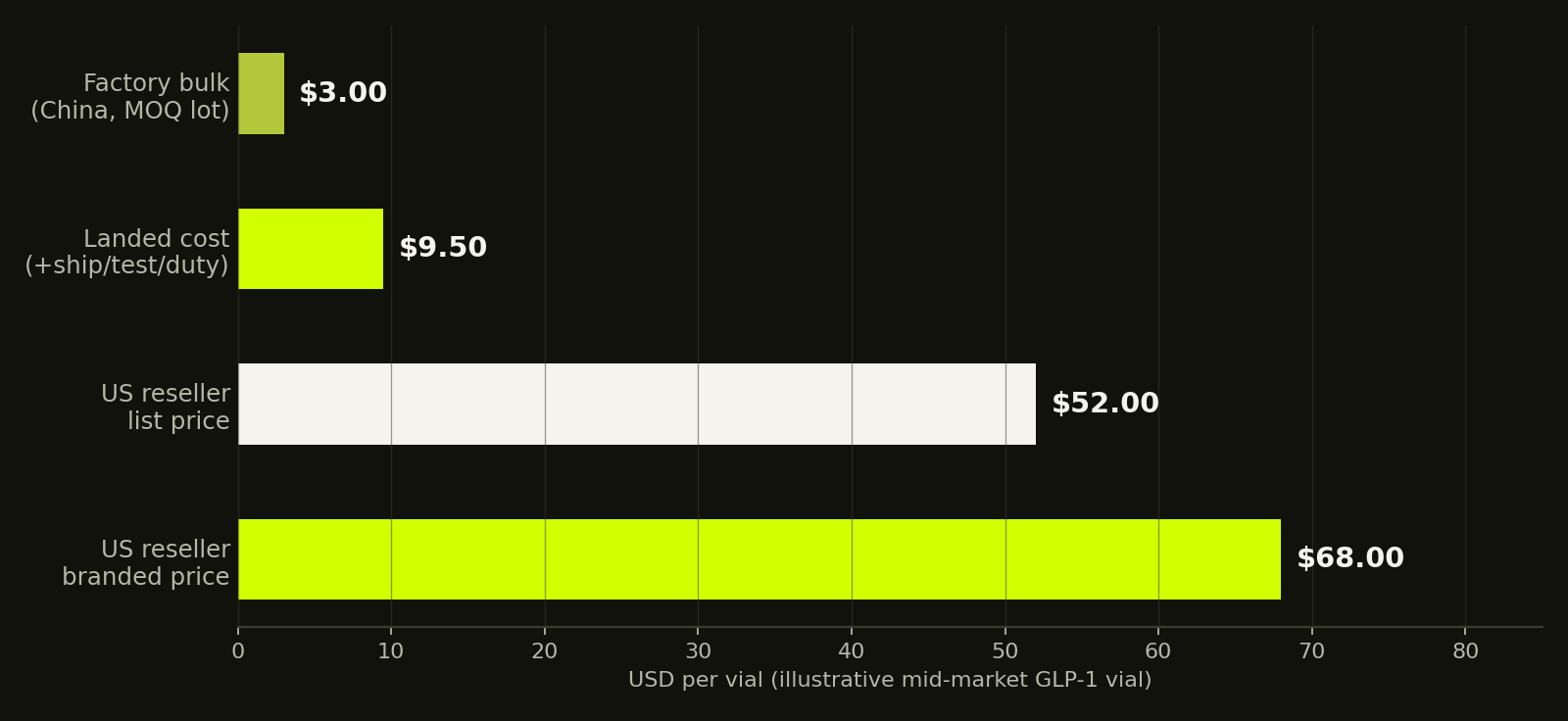
Roughly, yes — for cheap compounds at volume. B2B platform listings show tirzepatide raw material quoted from $28–100 per gram at gram-scale MOQs.[14] A gram of tirzepatide fills roughly 33 vials of 30 mg; at $60/g the API inside one vial costs under $2. Boxed, lyophilized 10-vial lots on wholesale marketplaces list around $10/vial at MOQ 10 — a number that includes the seller's margin, meaning factory floor cost sits lower still.[14] Cheap short-chain compounds (BPC-157, TB-500 fragments, GHK-Cu) run dramatically below GLP-1s per milligram, which is where the "$3 vial" figure lives.

Vial cost ladder
Anatomy of a mid-market GLP-1 vial — illustrative spread from factory bulk to U.S. retail [13][14]

The landed-cost reality

The supplier's per-gram quote is never your cost. Open sourcing guides itemize the stack: international shipping with cold chain ($100–300 per shipment), customs brokerage ($50–200), independent analytical testing of received material ($150–400 per batch), import duties (0–10% of declared value). For a premium compound like retatrutide, true landed cost typically settles at $450–750 per gram at meaningful quantities — still far below Western retail, but far above the sticker.[13]

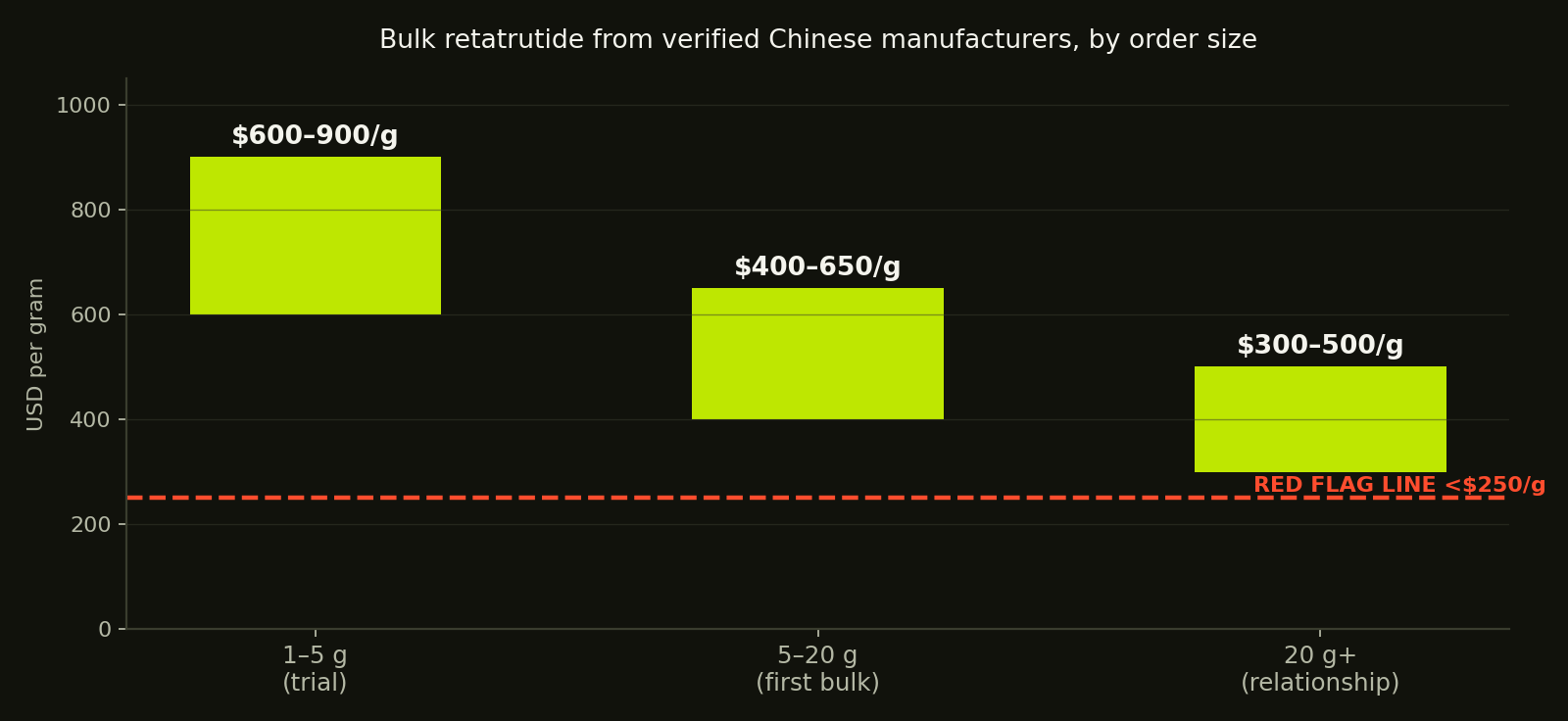
Bulk retatrutide pricing from verified Chinese manufacturers, by order tier [13]
Order tierVerified price rangeWhat this tier is for
1–5 g (trial)$600–900 / gPaying a premium to establish a quality baseline with a new supplier
5–20 g (first bulk)$400–650 / gWhere the bulk discount starts to matter; typical first serious order
20 g+ (relationship)$300–500 / gNegotiated on recurring-order commitment and payment terms
<$250 / gRed flagBelow synthesis economics for a 39-residue peptide — expect dilution or substitution
Bulk price ladder
The bulk price ladder — and the line below which the math stops working [13]

Where the margin actually leaks

// Chapter takeaway

The headline spread (~$3 → $50+) survives contact with reality — but as gross margin, not net. Disciplined operators model landed cost per vial, testing per batch, reserve-adjusted processing, and a failure rate before they price anything. The ones quoting the spread on forums are selling you the dream; the ones quietly modeling the stack are selling vials.

03The Payment War

Ask any peptide reseller what almost killed the business and you will rarely hear "the FDA." You will hear: "Stripe froze $40k the week before my supplier invoice." Payments are the market's true front line.

Why the mainstream rails are closed

Stripe's Prohibited Businesses list explicitly restricts sellers of unapproved pharmaceuticals and research chemicals; PayPal's Acceptable Use Policy prohibits prescription drugs and "drug paraphernalia," which its risk teams routinely extend to research peptides; Square follows suit.[8] These platforms are payment facilitators: they approve fast, underwrite later, and let automated monitoring catch up — meaning merchants are often onboarded quietly, allowed to scale, and then terminated without warning once a manual review flags the category.[8][10]

The termination mechanics are standardized and brutal:

// Field report — r/ecommerce, Oct 2025 [7]

A peptide merchant describes scaling to $300k/month before Stripe froze the account; a switch to Chase — courted on the strength of the numbers — ended the same way once internal compliance identified the product line. Their post-mortem is now community canon: no LegitScript, peptide keywords in the checkout flow, and TC40/SAFE dispute reports will each independently get you killed. Their survival rules: bank-to-bank backup processing, two processors minimum, a scrubbed website, and parallel B2B entities for wholesale accounts.[7]

What operators actually use

Processing cost comparison
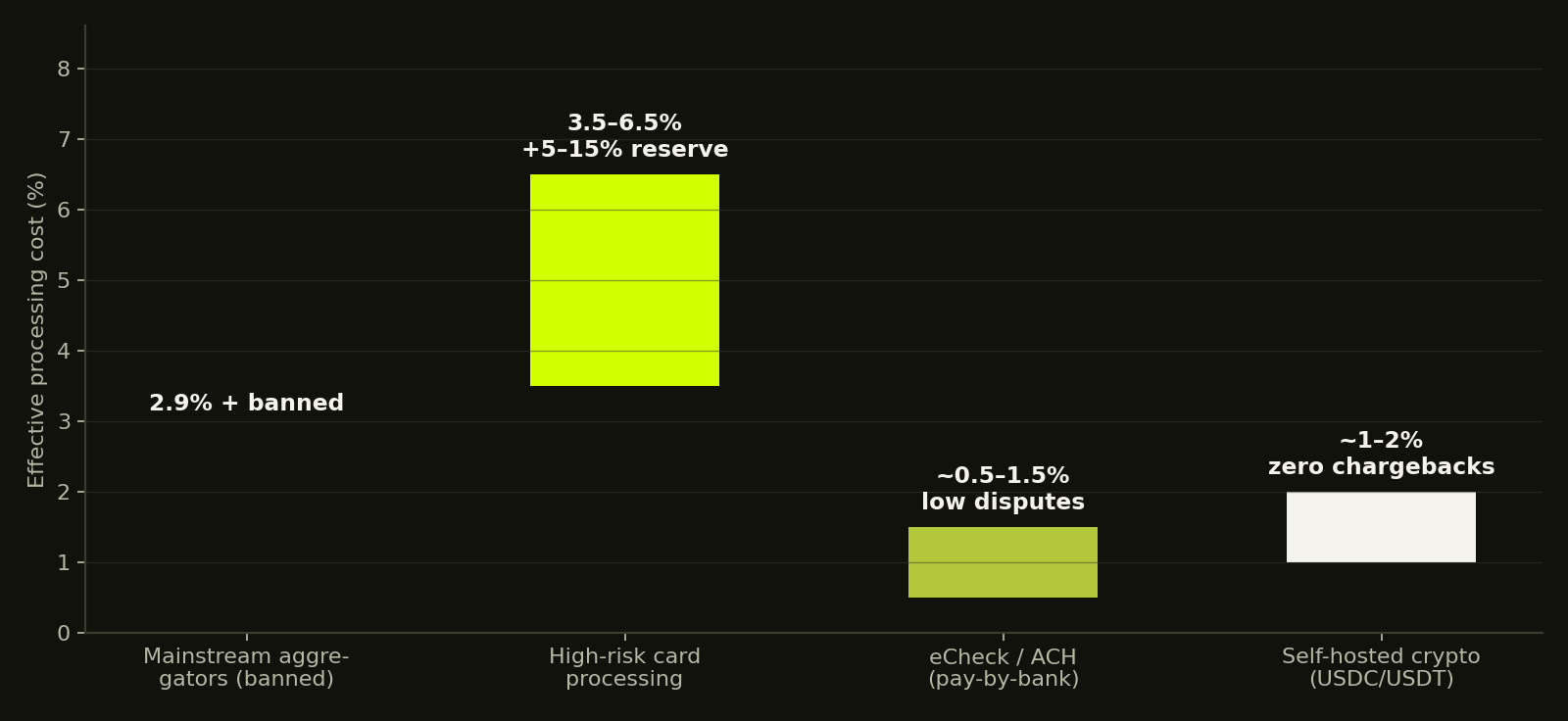
Effective cost of the four rails resellers rotate through [8][9][11][12]

1 · High-risk merchant accounts (the card rail that survives)

Specialist providers (Easy Pay Direct, AllayPay, Corepay, 2Accept, SecureGlobalPay, and similar) underwrite peptide merchants knowingly. The published price of survival: 3.5–6.5% per transaction, 5–15% rolling reserves, weekly payouts, and heavier documentation — ID, processing history, business registration, and a compliant website free of health claims.[9][12] Published tier tables put peptides in the "mid-tier high-risk" band at ~3.49% + $0.25 with domestic or offshore MIDs.[12] Some require LegitScript certification; others accept RUO sellers under alternative compliance frameworks.[10]

2 · eCheck / ACH (the community favorite)

Bank-to-bank payments are repeatedly called "the peptide merchant's best friend" in industry guides: materially lower processing costs than cards, far fewer chargebacks (bank transfers are hard to dispute), better tolerance for large orders, and less card-scheme scrutiny.[11] Pay-by-bank checkout also sidesteps Visa/MC oversight almost entirely and can offer same-day funding.[7]

3 · Self-hosted crypto gateways (the chargeback kill-switch)

Card-to-crypto onramps and self-hosted gateways settle in USDC/USDT to a merchant-controlled wallet; on-chain settlement is cryptographically irreversible, which permanently eliminates chargebacks, and a self-hosted stack has no central account to freeze.[8] The tradeoffs are conversion friction and the merchant's own compliance burden.

4 · The workarounds layer

The vetted shortlist

The names below are the ones that come back in every community thread for a reason: they publicly board peptide and RUO merchants, and their pricing is on the record. This is a snapshot, not an endorsement — underwriting criteria shift with every card-network bulletin, so verify current terms before signing anything. Apply to two or three in parallel; approval speed is a feature, not a convenience.

High-risk providers that actually board this niche [7][8][9][11][12]
ProviderRailPublished pricingField notes
Easy Pay DirectCard (high-risk MID)Custom; typically 3.5–6.5% + rolling reserveFull-service high-risk veteran; multi-MID load balancing built into the gateway[9][12]
AllayPayCard + eCheckMid-tier high-risk band, ~3.49% + $0.25Boards RUO sellers openly; bundles eCheck to cut card dependence[12]
CorepayCardCustom high-riskFast approvals for supplement/peptide verticals; offshore MID options[12]
2AcceptCardCustom high-riskSpecializes in "hard-to-place" nutraceutical and RUO merchants[9]
SecureGlobalPayCard + eCheckTiered high-riskPeptides listed among accepted verticals; chargeback pre-alerts included[12]
ACH / eCheck processorBank-to-bank~0.5–1.5% flatThe community favorite — low fees, almost no chargebacks, less card-scheme scrutiny[11]
Self-hosted crypto gatewayUSDC / USDTNetwork fees only (~0–1%)No central account to freeze; chargebacks cryptographically impossible[8]

Read the table the way veterans do: one card rail from the top five, one bank rail, one crypto rail. Three ways to get paid means a termination email is an inconvenience, not a funeral.

// The law of the niche

One processor is a countdown, two is a business. Every experienced operator runs a primary rail plus at least one independent backup (typically card + ACH, or card + crypto). The goal is not avoiding fees — it is ensuring that a single termination email can never take the store offline or trap a month of revenue for 180 days.[7][8]

04The Paper Trail

In an unregulated market, the Certificate of Analysis is the only currency of trust — and the community has built an entire verification economy around the fact that a shocking share of them are fake.

The verification economy

The benchmark institution is Janoshik Analytical, a Czech laboratory that accepts customer-submitted samples and — critically — publishes every result in a public database (public.janoshik.com), verifiable by task number and unique key. A COA claiming Janoshik credentials that returns no record in that portal is, by definition, fabricated.[24][28] Recognized alternatives include MZ Biolabs (Tucson), Freedom Diagnostics, Vanguard Laboratory, Chromate (QR-code report verification), and Colmaric Analyticals.[25] Community aggregators — Finnrick's index of published results and Peptigrity's shop-linked test database — turn individual reports into a cross-vendor public record.[25][26]

43%
of peptides tested by Janoshik in 2024 failed to meet label purity claims [27]
15–20%
of supplier COAs show significant discrepancies on independent re-verification [26]
$200–1k+
typical cost per third-party sample, depending on the panel [29]

Reading a COA like an auditor

01Name the lab. "Independent third-party laboratory" without a name is not a claim — it cannot be cross-referenced and provides no accountability path.[25]
02Verify independently. Janoshik results resolve in the public portal; Vanguard and Chromate have their own verification paths. If checking requires trusting the seller's PDF, it is not verification.[24][25]
03Read the chromatogram. A real HPLC trace shows a dominant target peak plus small impurity peaks and baseline noise. A single perfect spike with zero noise is a red flag for fabrication.[24]
04Match the batch. The COA must tie to the exact lot number on the vial — per-batch, published before purchase, not a generic document on request.[30]
05Know what it does not say. Standard HPLC confirms purity of the submitted sample — not fill weight (a "5 mg" vial could hold 2 mg), not heavy metals (needs ICP-MS), not sterility or endotoxins.[28]

The factory-test paradox

Here is the structural detail that even veteran forum buyers routinely miss: if a "factory" attaches a Janoshik report to its price quote, you are most probably talking to a middleman. The logic is pure operations. A Janoshik test is not made overnight — the sample has to travel to a laboratory on another continent, wait in queue, get analyzed, and come back as a report. A real synthesis factory cannot afford to freeze a finished batch in its warehouse for that long: production lines and cold storage run on constant rotation, and inventory that sits is inventory that bleeds money. So the serious factory does something else entirely — it runs its own local testing, continuously, on in-house or domestic lab equipment, and ships on the strength of those internal numbers.

The middlemen know this, and it is precisely the gap they live in. They buy the bulk, trusting the factory's internal QA they have learned to read over dozens of orders; they send their own sample to Janoshik; and then they present the overseas report — and themselves — as "the factory." The Janoshik letterhead you were told to demand as proof of factory status is, more often than not, proof of the opposite.

// Don't take the forums' word for factory reality

The standard forum wisdom — "only buy from factories that show Janoshik COAs" — is written by experienced buyers, not by anyone who has watched an overseas production floor rotate stock. That advice filters for middlemen while believing it filters them out. Treat self-proclaimed old hands accordingly: their sourcing scars are real, their model of how a factory operates usually is not.

There are two rational ways to live with this, and they differ in exactly one variable — who pays for the risk:

The two rational responses to the factory-test paradox
PathWhat it costs youWhat it buys you
Buy through the middlemanTheir margin, baked into every gramSafety. They already absorbed the testing risk and the sourcing risk — and they know which factories' internal QA has held up across dozens of batches. You are paying for their scar tissue.
Buy factory-direct, test yourself$200–1,000+ per batch sample[29], plus lead time and your own mistakesMaximum margin. No middle layer — and the Janoshik report you commission on the batch that actually landed becomes a public trust asset for your own storefront.

The borrowed COA

Open Janoshik's public database and scroll: among the customer names you will find pages of results booked under throwaway identities — JD, JP, MJ, OK, AAA. That anonymity is the loophole. Any dealer can point at any such report and shrug: that's mine — I just didn't want the attention, so I booked it under a random nick. There is no way for you to prove otherwise — and that is precisely why the trick persists.

The economics do the rest. One independent panel costs roughly $300[29], while the certificate it produces lets a seller price the same powder 10–20× higher than the identical uncertified listing overseas — judging by the car brands of successful resellers, the test pays for itself. Many U.S.-side sellers do it honestly: buy from verified overseas sources, submit the samples under their own name, publish per batch. Some simply show you other people's results and call them their own. And remember the limits even of a fully genuine report: it certifies the one vial that was mailed to the lab — nobody guarantees the batch sold to you is the batch that was tested.

// Why the last chapter exists

Hold this thought until the end of the playbook: below we list real sellers on both sides of the ocean — put their price lists side by side and you will see the same compound differing 10–20× with essentially one variable: whose name sits on the Janoshik report. Whichever path you take, your own supply-chain due diligence is one DHL envelope: community-standard practice is to send a sample from every incoming batch to a verifiable lab before listing it.[29] Vendors with QR codes on vials linking to public per-batch reports are defining the market's trust standard.[30] When a community test shows 3 of 10 products failing — including one budget "semaglutide" that was the wrong compound entirely — buyers learn to pay for paperwork.[27]

05The Brand Lab

Two resellers buy the same powder. One ships it in a zip bag with a handwriting scrawl; the other ships a crimped vial in a matte-black box with a batch QR code. Same molecule, 40% price difference. This is the chapter about that 40%.

The label is the storefront

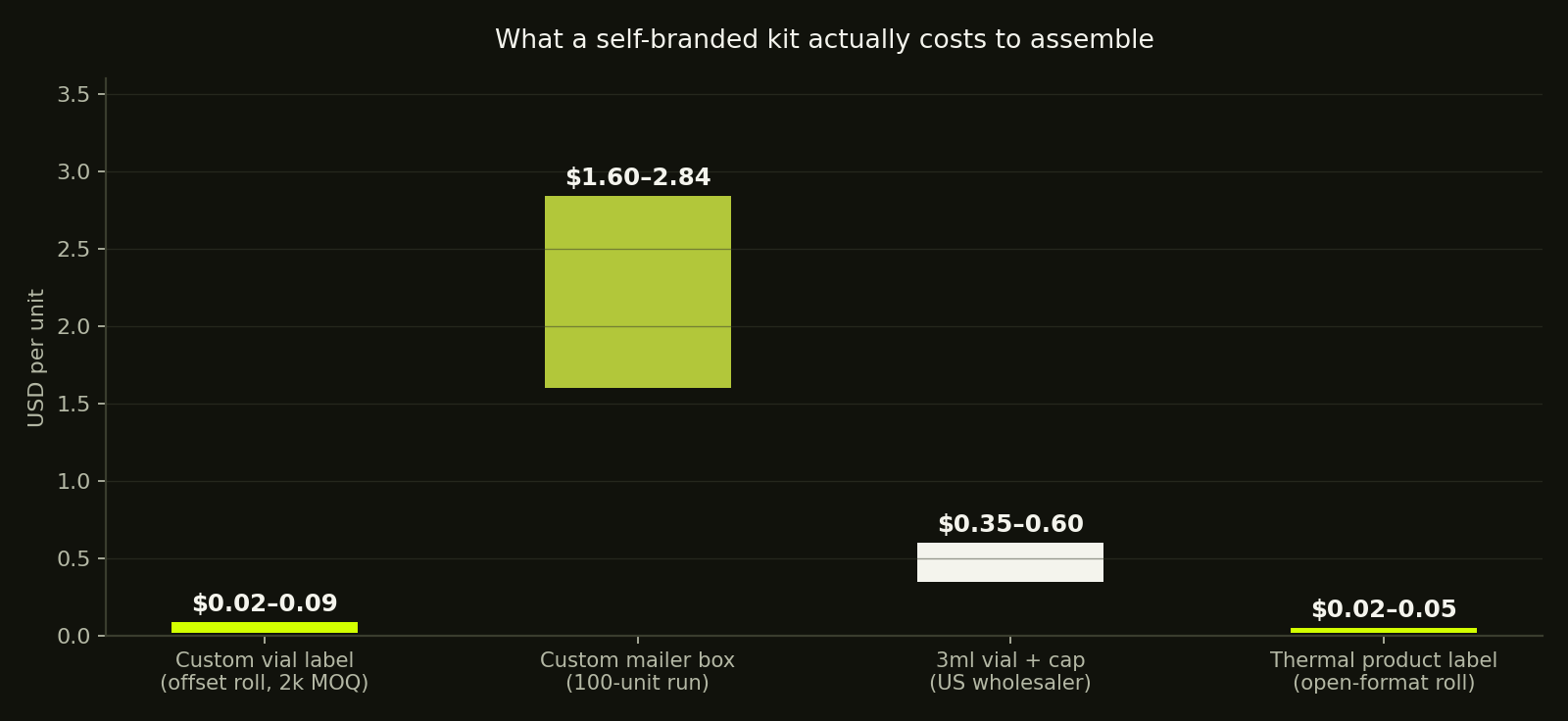
The standard canvas is the 1.5" × 0.75" wrap label for 3 ml vials — a size with an entire micro-industry behind it, from Etsy print shops selling pre-templated peptide labels to Alibaba offset printers offering waterproof, holographic stock at $0.01–0.12 per label at 100–2,000-piece MOQs.[15][31] Chinese pharmaceutical-label printers run 2 ml / 3 ml / 10 ml vial labels on BOPP with matte or gloss lamination at ~2,000-piece minimums with 5–15-day turnaround.[32]

COMPOUND NAME · MG LOT #2609-A · EXP 09/2028 FOR RESEARCH USE ONLY NOT FOR HUMAN OR VETERINARY USE · STORE 2–8°C compound + strength, no claims batch ID tied to public COA RUO statement, verbatim QR → batch lab report storage + no-human-use line

Fig. 5.1 — Anatomy of a label that survives both processor audits and customer scrutiny (illustrative composite of community practice)

The content rules are the inverse of marketing instinct: compound name, strength, lot number, storage, and the RUO/no-human-use statements — nothing else. No dosage, no benefits, no body imagery. Every warning-letter analysis shows the FDA quoting website copy as intent evidence; the label is where discipline starts.[3][4]

The printer on the desk

Nearly every small operator runs the same two-printer bench: an open-format thermal printer for shipping labels and batch/vial stickers, and offset-printed rolls from Alibaba for the hero product label. The comparison that circulates in seller communities:[17]

The printer shootout, scored for small e-commerce operations [17] — budget tier added from community field reporting
PrinterStreet priceLabel formatReal label costCommunity verdict
NIIMBOT M2[36]~$100–140Small rolls ≤2" (50 mm), 300 dpi~$0.01–0.03 / label + ribbonThe budget entry ticket. Thermal-transfer (ribbon), so prints survive freezer, BAC-water spills and friction instead of fading like direct thermal; sized perfectly for the 1.5"×0.75" vial wrap. The taxes: phone-app-first workflow, ribbon swaps
Phomemo M110 / M220-class clones[37]~$40–80App-paired rolls, 20–80 mmcheap hardware, app taxFine for a first test batch of stickers. Direct-thermal 203 dpi print fades in months — never put a lot number you'll need in a year on one; recent users report subscription-gated printing in the app
Rollo X1040~$280Open — any 4×6 / small roll$0.02–0.05 / labelThe default choice; Wi-Fi, driverless, ~1 label/sec, printhead rated ~650k labels
DYMO LabelWriter 5XL~$405Proprietary DYMO Authentic (RFID-locked)~$0.21 / labelEasy setup, but the RFID lock taxes you ~10× on consumables forever
Zebra ZD421~$300–450Open, ZPL/EPL$0.02–0.05 / labelThe upgrade at 200+ labels/day or ShipStation/ZPL workflows

The economics lesson embedded in the table is the market in miniature: DYMO's convenience costs roughly $2,100 more per 10,000 labels — operators feel that difference in month three.[17] The budget tier plays a different game: a NIIMBOT M2 pays for itself against a DYMO within roughly the first 500 labels, which is why it circulates in seller chats as the standard "first printer" — with the explicit caveat that you graduate to Rollo or Zebra the moment daily volume makes a phone app the bottleneck.[36]

Boxes: the two-layer system

Established practice for small brands: an interior "experience" box (branded folding carton holding the vial kit) inside a plain outer shipping mailer. A documented 50-unit breakdown puts a custom-printed interior box at ~$2.10 and a plain outer mailer at ~$0.85 — a high-value unboxing for under $3.[18] The supplier shortlist resellers actually trade between:

Low-MOQ custom box suppliers used by small brands [18][19][20]
SupplierMinimumBallpark unit costKnown for
Packlane1 unit (HDPrint) / 25–50 paperboard~$2.84 (6×4×3 mailer @100)Best 3D online design tool; 7–18 business days
Arka10 unitsfrom ~$0.99 (small boxes)Eco/FSC stock, Shopify integration, dieline downloader
PackolaNo minimum~$3.84 (8×8×3 @100)3D design suite, stickers/inserts; slower 20–25 day turn
Fantastapack5+ production~$2–3Cheapest quotes, fast US production
Packhelp30 units~$1.60 (mailer @240)Recurring-order pricing, ~7-day turnaround
Teal Packaging50 unitsfrom $0.44 at volumeFree design help + free US shipping
Branding cost stack
Per-unit cost of assembling a self-branded kit [15][17][18][19]
// The margin math of owning the label

Full self-branding adds roughly $3–5 per shipped kit (hero label + box + thermal labels + inserts). In exchange, the same inventory supports a $15–30 price premium over zip-bag resellers, dramatically fewer "is this legit?" support tickets, and — because the lot number on the label resolves to a public lab report — the single strongest repeat-purchase driver the niche has. White-label OEM runs from factories exist too, but community consensus holds that controlling the label yourself keeps the COA chain honest: you can't quietly relabel a failed batch you never see.[26][30]

06The Sourcing Minefield

Every chapter until now was about operations. This one is about survival — because the single most dangerous step in the entire business is the first one: finding someone to buy from.

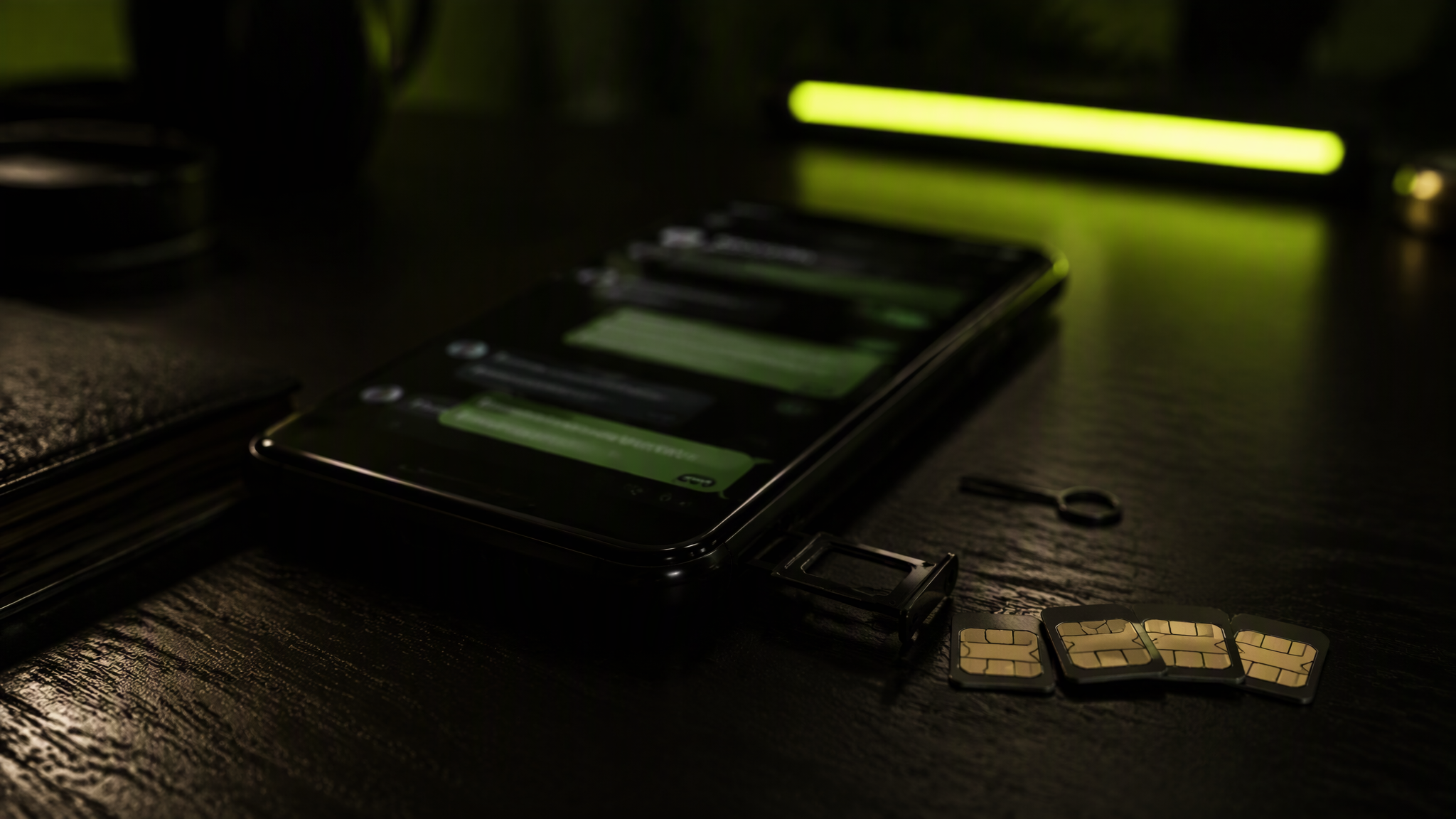
Sourcing phone with SIM cards
The wholesale contact layer — where the business is won or lost before a single vial exists

Why Google is the worst sourcing tool

49/50
of "wholesale factories" surfacing in Google results are scam operations — field consensus across sourcing communities
~0
real synthesis factories with any meaningful Google presence — they don't know what a results page is, and they don't need to

The arithmetic behind that ratio: an unregulated grey market, no dispute forum, and a steady inflow of buyers holding no information — a scammer's ideal habitat. The scammers simply exploit the fact that the buyer has no map. Community fraud guides describe the pattern with remarkable consistency: the polished websites, "wholesale reps," stolen lab reports, fake tracking numbers, and even fake testimonials that a search for "peptide wholesale" surfaces first. The deeper a buyer goes into the China wholesale side, the more the trade runs on trust and perception — and the more the professionally-packaged scam outperforms the honest but shabby factory storefront.[23] Search ranking is bought; credibility in this market cannot be. The result is a selection effect: the louder a "factory" advertises, the less likely it is one. Legitimate manufacturers with ISO 9001 and batch-specific COAs sit next to intermediaries who buy low-grade material, relabel it premium, and vanish after payment clears.[13] And the real factories? Their world is distributor relationships, trade fairs and Telegram channels — keyword-search your way and you will find the people who paid to be found, which in this market is almost the definition of the wrong people.

The five faces of the "factory"

Every wholesale contact you will ever meet — Google, Telegram, WhatsApp, a trade fair — resolves to one of five species. Learn to sort them in one conversation and the minefield becomes a map:

01The SIM-farm scammer. Operates from anywhere in the world on rotating Chinese SIM cards, presenting as a factory rep — professional PDF, stolen COAs, polished chat English. The entire identity infrastructure exists to be burned and replaced; the product is your prepayment, not the peptide.
02The shadow middleman. Buys from verified, reliable factories and sells under the factory's identity. The best of them are genuinely useful — fly to China with a real relationship and they can even walk you through the production floor as if it were theirs. You pay their margin for their sourcing scar tissue.
03The margin-feeder middleman. Some work with a single factory, some with all of them — and if you signal that you chase maximum margin and fast flips over reputation, they can offer you, in plain text, sugar powder priced as a peptide. They will supply the full paperwork stack — Janoshik-style COAs, QR codes, the works — and you will feel factory-direct. Nobody guarantees the ampoule that went to the lab is the one that ships to you. As veteran buyer Matthew Cock puts it: "In a scam, everything is great and fun. The only downside is that you're dealing with scammers."
04The actual factory. One of the best options on the board. Some factories watched the middlemen's margins and dropped their minimums — occasionally to 3 kits (~30 vials). The catch from Chapter 04 applies: a really good factory doesn't bother with Janoshik — it tests in its own labs, and its long-time buyers know the factory guards its reputation harder than any certificate.
05The science-center trading house. The uninformed file these under "just another middleman." Wrong category: the science centers behind them officially supply only licensed laboratories and legitimate pharma — and these houses buy product out through their own licenses. Considered the top of the quality pyramid — though the best cosmetic factories have learned to synthesize no worse.

The three kinds of factory

"Factory" itself is a spectrum, and the price list never tells you which end of it you are on:

01Grandpa Li's garage. The cheapest equipment money can buy, minimal QC, prices that break synthesis economics. The origin point of most "too good to be true" offers.
02The cosmetic factory. The widest band of the pyramid — quality ranges from garage-grade to genuinely excellent, sometimes indistinguishable from the top tier. Independent verification exists precisely because of this band.
03The science center. You can count them on the fingers of one hand. Research-grade production supplying licensed pharma — reachable for outsiders only through the affiliated trading houses of species 05 above.

The WhatsApp tell

Here is the structural fact the community reads like tea leaves: WhatsApp has been blocked in mainland China since 2017, along with essentially every Meta service.[22] A mainland factory cannot casually run WhatsApp — maintaining it requires VPN infrastructure and, because Meta bans the accounts in industrial quantities, a constant supply of fresh SIM identities to re-register.

Meta's own enforcement numbers show why that treadmill exists: the company took down 6.8 million WhatsApp accounts tied to scam operations in the first half of 2025 alone, many run from organized scam centers that cycle victims across platforms — text → WhatsApp → Telegram → crypto — so no single service sees the whole scheme.[21][33]

// The community's working theory — and the logic behind it

Reseller communities state it bluntly: most "wholesale factory reps" on WhatsApp are scammers, and SIM-card rotation is a line item of the scam business model, not of legitimate manufacturing. The reasoning is structural, not anecdotal: a real factory's greatest asset is a stable identity — a domain, a company registration, a decade of returning buyers. Burning WhatsApp accounts and re-registering SIMs is an expense only an operation planning to disappear would budget for. A seller who is organized around replacing their own identity has told you their business model in advance.[22][21]

Where the real trade lives: Telegram

The market's actual center of gravity — confirmed across vendor databases that list everything "from FDA-registered compounding pharmacies to anonymous Telegram channels"[27] — is Telegram: factory channels, reseller groups, group buys, and community testing threads where buyers pool money to send batches to Janoshik and publish the results. Telegram's appeal for legitimate sellers is practical: it works in China without gymnastics, channels scale to thousands of buyers, group history creates a reputation ledger, and the community's fraud-hunting culture polices openly — scam reports, COA callouts, and verification threads sit in the same feed as price lists.[23][26] An account with three years of visible history and a crowd that vouches — and criticizes — in public is a very different signal from a WhatsApp number created last Tuesday.

The red-flag checklist (community-standard)

Compiled from open fraud guides and sourcing playbooks [13][23][24]
SignalWhat it usually means
Pricing below ~$250/g for complex peptidesBelow synthesis economics — dilution, substitution, or exit scam [13]
WhatsApp-first contact from a "Chinese factory"App is blocked in China; identity-burning operation [21][22]
COA from an un-nameable lab, or PDF-only "verification"Fabricated documentation; real labs are searchable [24]
Crypto-only payment, no invoice, no company identityIrreversible payment + no recourse = exit by design [23]
"Limited-time" pressure, subscription urgencyUncommon in legitimate research-chemical sales [34]
No community footprint — absent from Telegram groups, forums, Finnrick/PeptigrityA ghost identity is a disposable identity [26]
Verifiable lab portal entry, stable domain, years of public channel history, accepts trial ordersThe green-flag stack — proceed with a small test order anyway [13][24]
// Chapter takeaway

The sourcing hierarchy the community converged on: Google ads < Alibaba storefronts < B2B directories < Telegram groups with public history and community verification. Start with a trial order at trial-tier pricing, test it at a verifiable lab, and scale only what survives. Nobody legitimate is offended by a small first order; only scammers need it to be big.

07The Operator's Week

Strip away the mythology and the average successful RUO reseller runs a small, boring, documentation-heavy e-commerce business — with two unusual verbs: verify and survive.

What "regular resellers" actually do

The realistic startup tiers

Community-consensus budget tiers for entering the market (illustrative synthesis of cited costs)
TierBudgetWhat it buysHonest assessment
Micro-test~$1–2k50–100 vials of 1–2 compounds, one lab panel, thermal printer, offset label run, simple storefrontValidates demand and the supply line; too thin to look credible across a catalog
Credible launch$5–15kFocused catalog (3–5 compounds), standing testing cadence, branded packaging, high-risk processor reserve, basic SEO/email stackThe range where buyers stop asking if you're legit
Full operation$25k+Broad catalog, multi-MID processing, fulfillment help, legal review, compliance-first infrastructureConstraint shifts from capital to channel velocity and legal discipline

For scale calibration: pharmacists discussing "doing it the right way" — sterile, registered, fully compliant — estimate $100–250k in upstart costs.[35] The grey market exists precisely in the space that number creates.

The failure modes, in order of body count

01Scammed at sourcing. Wired to a WhatsApp "factory rep" with a professional PDF and a fresh identity. Chapters 06 exists because this is #1.[23]
02Frozen at payments. One rail, no backup, a month of revenue held 180 days at the exact moment the supplier invoice lands.[7][8]
03Burned by a bad batch. Skipped verification on order #4 because orders #1–3 tested clean; community test results forced a refund wave.[26][27]
04Talked like a drug company. Wellness claims and dosing content turned an RUO storefront into FDA "intent evidence."[2][3]
05Starved on distribution. Built the store, discovered ads are banned, had no community presence to sell into.[7]
// Chapter takeaway

The operators who last share a recognizable temperament: paranoid about sourcing, redundant about payments, obsessive about paperwork, silent about benefits. The product is not the peptide. The product is trust, manufactured in public, one verified batch at a time.

08The Door

Everything in this playbook was assembled from open sources — the same material anyone can find, lose a month to, and still misread. This last chapter is the part open sources usually can't give you: a current field map of who is actually selling — on both sides of the ocean — and what each one reads like up close.

Put the two tables below side by side and the entire playbook becomes arithmetic: the same compound routinely differs 10–20× in price between the stateside list and the overseas list, with essentially one variable — whose name sits on the Janoshik report (see Chapter 04). That spread is the business. These are field notes, not endorsements: every entry still requires your own trial order and independent lab verification, exactly as Chapter 06 prescribes.

The stateside list — resellers & middlemen

U.S.-facing vendors — field notes from the editor's database (snapshot, 2026)
VendorWhat it reads asField notes
bulkpeptidewholesale.comMiddleman, own brandCould be a good partner. Sells under its own label; some independent tests have failed — but those results alone don't reveal which factories or other resellers it buys from.
thekitqueens.comMiddleman, micro-teamA small two-person team buying from other vendors. Straightforward about what it is; a potential partner.
thepeptidetheoryco.comUnverified sourcingPromises careful sourcing but names neither the manufacturers nor the countries of manufacture.
peaklabpeptides.comTesting ≠ origin"USA Lab Verified" is a claim about testing — it does not prove the products are manufactured in the U.S.
peakpeptides.shopClaims U.S. synthesisSocial profile says "American made" and claims direct sourcing from licensed U.S. synthesis labs — but names none, so U.S. manufacture still needs verification. Note the near-name collision with PeakLabPeptides.com: confirm you're dealing with who you think you're dealing with.
bulkpeptidesupply.comUnnamed facilitiesClaims ISO-certified facilities without naming the facilities or their countries. Independent testing record: nine failed tests out of 36.
bulktides.usU.S. fulfillmentAdvertises U.S. fulfillment — domestic delivery should be quick and affordable.
wholesalepeptidescompany.com"Sourced in USA"Their "sourced in the USA" means a U.S.-based buying team and U.S. stock — not necessarily U.S. manufacture. Offers private labeling: American-looking branding alone proves nothing.
pandapandago.comCapacity-constrainedAppears to run on a single salesperson barely keeping up with the order volume.

The overseas list — factory-side

Factory-side sources — field notes from the editor's database (snapshot, 2026)
SourceWhat it reads asField notes
jasminebloomlab.comVery reliable partnerPartners report dozens of COAs above 99.3% purity, with a single report at 98.7%. The strongest paperwork record in this list.
northsciencepark.comHidden gemBehind the ugliest website on Earth hides a real brilliant.
whitetigerstar.comVerified cosmetic factoryCan produce whatever format you want — vials, pens, packed boxes; everything depends on your MOQ.
// The live version
This list is a snapshot.
The market is not.

We track this market continuously and keep expanding the database — new vendors, fresh test results, scam callouts, price movements. If you want the current version of the list at any moment, it lives where the market lives:

→ SUBSCRIBE: @greylocator_bot ON TELEGRAM

Inclusion in the list is not an endorsement; every entry still requires your own trial order and independent lab verification — see Chapter 06. The list is provided for research purposes only.

The playbook stands on its own: the machine (Ch. 01), the margin (Ch. 02), the payment war (Ch. 03), the paper trail (Ch. 04), the brand lab (Ch. 05), the minefield (Ch. 06), and the operator's week (Ch. 07). The list changes weekly; the method doesn't. Everything else is execution.

This document aggregates publicly available information for educational purposes and reflects conditions as reported at compilation time (2026). It does not constitute legal, medical, financial, or business advice; does not encourage the purchase, sale, or use of any unapproved substance; and makes no representation that any described practice is lawful in any jurisdiction. Research-use-only peptides are not approved by the FDA for human or veterinary use. Consult qualified legal counsel before acting on anything in this document.

SSources

All factual load-bearing claims trace to the open sources below (APA-style, with URLs). Community-forum material is cited as field reporting, not as verified fact.

[1] Peptide Journal. (2025, November 18). Research use only peptides: Legal gray area explained. https://peptidejournal.org/legal/research-use-only-peptides-legal-gray-area-explained
[2] Inhouse.ai. (2026, June 24). How to sell peptides legally: A guide for med spas, telehealth, and online distributors. https://www.inhouse.ai/playbooks/article/how-to-sell-peptides-legally-a-guide-for-med-spas-telehealth-and-online-distributors
[3] pharmaphorum. (2026, September 2). FDA issues warning letters to five unapproved GLP-1 websites. https://pharmaphorum.com/news/fda-issues-warning-letters-five-unapproved-glp-1-websites
[4] BioSpace. (2024, December 18). FDA issues warning letters against online GLP-1 sellers. https://www.biospace.com/fda/fda-issues-warning-letters-against-glp-1-sellers
[5] Peptide Journal. (2025, December 28). FDA warning letters to peptide companies: Analysis. https://peptidejournal.org/legal/fda-warning-letters-to-peptide-companies-analysis
[6] U.S. Food and Drug Administration. (2025, February 26). Warning letter to USApeptide.com (MARCS-CMS 696885). https://www.fda.gov/inspections-compliance-enforcement-and-criminal-investigations/warning-letters/usapeptidecom-696885-02262025
[7] r/ecommerce. (2025, October 3). Stripe froze my peptide payments & Chase made it worse — what no one tells you about high-risk processing [Field report]. https://www.reddit.com/r/ecommerce/comments/1mj9zru/
[8] PayRam. (2026, June 5). 10 best payment processors for peptide merchants in 2026. https://payram.com/blog/best-payment-processors-for-peptide-merchants
[9] 2Accept. (2026, March 26). How can you secure reliable payment processing for your peptide business? https://www.2accept.net/blog/how-to-secure-reliable-payment-processing-for-peptide-business
[10] onPoint Studio. (2026, March 23). 10 peptide payment gateways that won't shut you down (2026). https://onpoint.to/10-peptide-store-payment-gateways/
[11] Adaptiv Payments. (2025, October 27). Peptide merchant account guide: Secure high-risk payments. https://adaptivpayments.com/blog/peptide-merchant-account-solutions
[12] 2Accept. (2026, May 25). Merchant account for peptides business — high-risk rate tiers and chargeback defense stack. https://www.2accept.net/industries/peptides
[13] SeekPeptides. (2026, February 22). Bulk retatrutide from China: The complete sourcing, quality, and safety guide. https://www.seekpeptides.com/blog/articles/bulk-retatrutide-from-china
[14] LookChem. (n.d.). CAS 2023788-19-2 — Tirzepatide supplier listings (FOB price ranges, MOQs). https://www.lookchem.com/cas-202/2023788-19-2.html
[15] Alibaba.com. (n.d.). Custom printing 3ml vial labels — waterproof, holographic stock, $0.01–0.12/unit listings. https://www.alibaba.com/showroom/printing-3ml-vial-label.html
[16] PSPeptides. (2026, June 17). Gray market peptides: Best vendor guide 2026. https://pspeptides.com/blog/gray-market-peptides-vendors/
[17] GadgetsChamp. (2026, April 5). Best thermal shipping label printers: Rollo vs DYMO vs Zebra. https://gadgetschamp.com/printers/best-thermal-printers-shipping-labels/
[18] Build A Box Online. (2026, July 17). Jewelry brand packaging: The two-box system — real 50-unit cost breakdown. https://buildaboxonline.com/blogs/news/jewelry-brand-packaging-the-two-box-system-for-luxury-presentation-and
[19] Fit Small Business. (2023, August 8). 8 sources for the best custom mailer boxes & packaging (MOQs, unit pricing, turnaround). https://fitsmallbusiness.com/where-to-buy-custom-boxes/
[20] Teal Packaging. (2026, August 2). 7 best Packlane alternatives for custom packaging (MOQ and pricing comparison). https://tealpackaging.com/best-packlane-alternatives/
[21] The Hill. (2025, August 6). Meta bans 6.8 million WhatsApp accounts linked to scam operations. https://thehill.com/policy/technology/5439760-meta-whatsapp-scam-ban/
[22] Gizmodo. (2026, July 20). Is WhatsApp blocked in China? How to unblock it in 2026. https://gizmodo.com/best-vpn/unblock-whatsapp-china
[23] Biohacking & Longevity Group (Skool). (2026, May 13). How to spot a peptide scammer [Community field guide]. https://www.skool.com/biohacking-and-longevity-group-3757/how-to-spot-a-peptide-scammer
[24] NorthPeptide. (2026, May 19). Peptide vendor scams: 8 red flags + COA checklist (2026). https://northpeptide.com/recent-research/got-scammed-buying-peptides-how-to-avoid
[25] Biohack London. (2026, May 8). Independently verified UK research peptides: What "lab tested" means; Shotlee. (2026, July 27). Janoshik alternatives: 5 other peptide testing labs. https://www.biohacklondon.com/insights/independently-verified-uk-research-peptides · https://www.shotlee.app/janoshik-alternatives
[26] Peptigrity. (n.d.). Independent Peptigrity & lab tests — 15–20% of supplier COAs show significant discrepancies on independent verification. https://peptigrity.com/about
[27] The Peptide List. (2026, January 14). We sent 10 peptides to a lab. 3 failed — independent testing across 4 vendor tiers. https://thepeptidelist.com/articles/peptide-lab-testing-investigation
[28] NorthPeptide. (2026, May 6). What Janoshik testing actually tells you (and what it doesn't). https://northpeptide.com/recent-research/janoshik-testing-explained
[29] Peptide Hackers. (2026, January 15). Third-party peptide testing guide: HPLC, Janoshik & purity ($200–1,000+ per sample). https://www.peptidehackers.com/blogs/q-a/third-party-peptide-testing-guide
[30] Peptide Mind. (2026, July 11). 10 best peptide companies of 2026, ranked by lab tests — documentation and per-batch COA standards. https://peptidemind.com/best-peptide-companies-2026
[31] Etsy. (n.d.). Peptide vial labels for 3ml & 5ml vials — 1.5" × 0.75" templated labels. https://www.etsy.com/listing/4407501120/
[32] MC Package. (2024, December 10). Custom pharmaceutical vial labels for 2ml, 3ml, 10ml — BOPP stock, 2,000-piece MOQ. https://www.mc-package.com/product/custom-pharmaceutical-vial-labels/
[33] Fox News. (2025, August 11). WhatsApp bans 6.8M scam accounts, launches safety tool — cross-platform scam cycling. https://www.foxnews.com/tech/whatsapp-bans-6-8m-scam-accounts-launches-safety-tool
[34] Alibaba Plantin. (2026, January 6). How to choose the best retatrutide peptide 10mg vial bulk pack — pricing tiers and caution flags. https://plantin.alibaba.com/buyingguides/retatrutide-peptide-10mg-vial-bulk-pack
[35] r/pharmacy. (n.d.). "I should start my own peptide business" — compliant-path cost estimates [Professional discussion]. https://www.reddit.com/r/pharmacy/comments/1mpv6v5/
[36] NIIMBOT. (2026). M2 2-inch thermal transfer label maker — 300 dpi, ribbon-based, vial-label reviews; Hagensieker, J. (2024, July 30). NIIMBOT M2 thermal transfer label maker review. https://niimbots.com/products/m2-2-inch-thermal-transfer-label-maker · https://hagensieker.com/2024/07/30/niimbot-m2-thermal-transfer-label-maker-review/
[37] Phomemo. (2025, June 15). Phomemo M220 vs M110 — 203 dpi direct thermal, Print Master app; Trustpilot. (2025–2026). Phomemo customer reviews — subscription-gated printing complaints. https://phomemo.com/nl/blogs/phomemo-news-2/phomemo-m220-vs-m110-which-portable-label-printer-is-right-for-you · https://www.trustpilot.com/review/phomemo.com

THE RUO PLAYBOOK · GREY/MARKET BRIEFING VOL. 06 · COMPILED 2026 · RESEARCH USE ONLY · NOT FOR HUMAN CONSUMPTION · EDUCATIONAL DOCUMENT — NOT LEGAL, MEDICAL, OR FINANCIAL ADVICE